
-
2020+
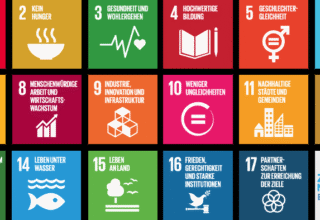
Climate protection, circular economy, and sustainable development goals take center stage
The United Nations’ Sustainable Development Goals, circular economy, and resource efficiency are part of all internationally funded development projects. The principles that have guided Austria Recycling’s work for decades are now being addressed on a broad scale. Existing social injustices, issues, and initiatives are finally entering the public consciousness, being discussed, and will hopefully be resolved or fully integrated in the near future. Minority rights, diversity, equal opportunities for all genders, and climate protection are just a few of these issues. -
The 2010s

Austria is now regarded as an environmental model country.
In many ecological concepts Austria is a role model for other countries. For instance, waste management, environmental management, sustainability management. Consequently, Austria Recycling exports Austrian know-how worldwide. The focus lies on Asia. In other words, the Austrian association has established itself as a recognised partner organisation for (international) projects on resource conservation, improvement of resource efficiency and cleaner production (RECP) in organisations. Most importantly, Austria Recycling combines its own environmental competence with the organisational development competence of its sister organisation Gesunde Organisationen (GO).
-
The 2000s

“Environmental protection is not an ‘end of pipe’ solution” moves into the mainstream
It is becoming increasingly clear to business people and politicians that environmental protection and waste avoidance cannot begin with the ‘end of pipe’ approach. So, Austria Recycling is researching sustainable consumer behaviour. In addition, together with its sister organisation Austria Recycling & Co Consulting Gmbh (ARECon) it is developing a programme for operational environmental protection. Most importantly, that programme begins at the source and is tailored in particular to small and medium-sized enterprises.
-
The 1990s

The waste problem is getting worse, landfill space is becoming scarce and expensive
Austria Recycling develops comprehensive waste disposal systems for waste paper, waste glass and waste metal. The association operates at the interface between citizens, municipalities, political leaders and industries. And it develops disposal solutions that are still in use today.
-
The 1970s

The oil price shock throws a glaring light on the value of raw materials and their finiteness
Therefore, permanent disposal systems with special containers are replacing the sporadic house collections.
-
The 1960s

There is a surplus problem (mountains of rubbish) and a shortage problem (scarcity of raw materials) at the same time
Austria Recycling starts the waste paper collection to turn Minus and Minus into Recycling-Plus.
-
1946

Austria suffers from post-war economic shortages
Austrian Production Promotion Company ÖPG is founded. It is entrusted with the task of supplying the industry with (secondary) raw materials. ÖPG later became Austria Recycling.
2020
1946